Knowledge Base
The knowledge base is DSAgt's catalog of domain knowledge, reference corpora and your own documents, that the agent searches to ground its work on scientific data processing and AI-readiness evaluation.
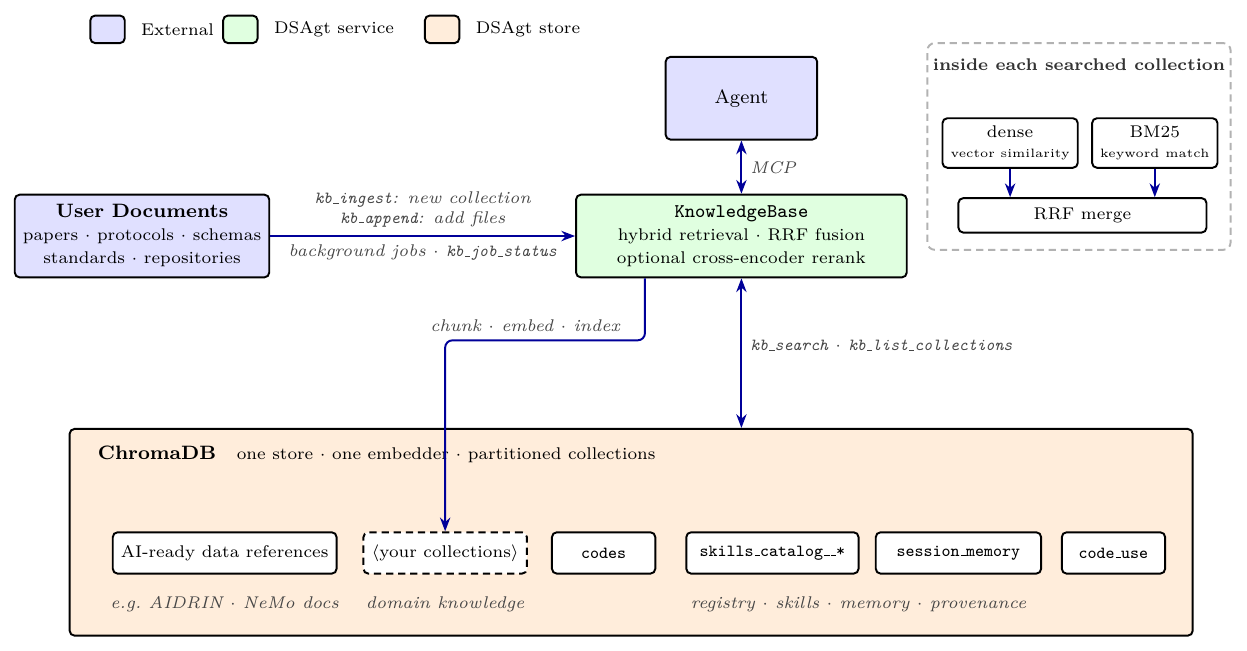
Domain-knowledge collections
| Collection | Source | Populated by |
|---|---|---|
| Reference corpus | NeMo Curator (data-curation references) | dsagt init (chosen collections) |
| Your documents | Papers, standards, protocols, schemas you ingest | Agent's kb_ingest |
The agent has five knowledge base tools: kb_ingest (index a folder into a named collection; the ingest runs in the background), kb_append (add documents to an existing collection), kb_job_status (poll a background job), kb_search (retrieve across one or more collections, with a where metadata filter and regex or substring filters over the chunk text), and kb_list_collections (every collection with its purpose, the metadata keys a where filter takes, and its chunk count).
Hybrid vector search
Retrieval is hybrid, dense semantic embeddings fused with sparse BM25 keyword matching, per collection by default:
- Semantic embeddings match paraphrase and synonymy: a query about "missing values" finds a passage on "null rates" with no shared words.
- BM25 keyword matching matches the exact terms embeddings under-rank (identifiers, gene names, parameter flags, standard names), where a literal match matters.
- Per-collection partitioning scopes a search to a domain, so a materials-science query is ranked against materials references only.
The default embedder is BAAI/bge-small-en-v1.5 run locally on onnxruntime from the ONNX export the model's repository publishes (133 MB, downloaded once).
Shared vector store
The same vector store also holds DSAgt's memory (explicit and episodic), the skill corpus, and the execution records (the code_use collection). Each is a separate collection in that store, sharing one embedder and one ChromaDB; the linked pages describe each collection.
Setup
dsagt init sets up the knowledge base from your choices in the interactive menu.
Try it
dsagt init            # name it `demo`, and check `nemo_curator` at the knowledge-collections menu
dsagt start demo
Then, in the agent, substituting <your-docs-folder> with any folder of your
own documents (papers, protocols, schemas):
-
Ingest the docs in
<your-docs-folder>into a collection nameddomain. -
Search the
domainandnemo_curatorcollections for how to assess data quality.